Stop asking yourself to be stronger in the exact moment you feel weakest.
Find the moments that keep pulling you back. Change what comes before them. Prepare the next move while you are calm.
US web offer. $29.99 every three months, or $14.99 per month. No free trial.
1
Smoking is not a decision you keep making. It is a loop that runs by itself.
Think about the last one. Did you decide to have it? Or did you get out of the car after work and your hand was already moving, because that is what you have done in that exact spot a thousand times.
The first coffee. The first hour awake. The second the phone comes out. None of that is twenty decisions a day. It is so automatic that it barely belongs to you any more.
2
A real decision can still leave the old moment untouched.
You may have decided before and meant it completely. The coffee, the drive, and the bad afternoon still arrived in the same shape.
You have been trying to out-argue something that was never listening, because it is not making an argument. It is just running.
3
Start with four things you can actually see: the place, the packet, what you are doing, and what your hands are doing.
A place, a distance, an activity, and a free hand give you somewhere practical to begin.
Notice what is not on it. Nothing about your character. Nothing about how badly you want it.
4
Take those away one at a time and the loop has nothing left to run on.
Move the pack from beside your desk into the closet. Now you have to stand up, you have to walk there, you have to get it. That is not willpower. That is three metres.
Take the ashtray off the table. If you really want one, you go down to the kitchen, put a bit of water in a glass, and use that. You will still smoke it. You will just have had four chances to not.
And the one you will not expect: scrolling with a cigarette in your hand becomes scrolling with a pen in your hand. One hand on the phone, one hand on the pen. It is already flipped, and you did not have to resist anything.
It is simple on purpose. None of it asks you to become a different person before you can try it.
5
The hard part was never the plan. It was knowing which moments to take apart.
“When I want one” is an honest answer, but it is not yet something you can work with.
“i went out of my car after work and imediately got a craving for smoke because thats what i did 1000 times”
You cannot dismantle a moment you cannot see. And after ten or fifteen years, none of it is visible any more. It is just what you do.
6
Write down the real moments and see whether anything comes back.
Write down when you smoke, and why. That is the entire exercise. Not to feel bad about the number. To find out where the loop actually lives.
You may see a familiar time, place, or thought return. You may notice something you did not expect. Either way, you are working with your own day instead of a guess.
7
If a window repeats, you no longer have to defend the whole day.
Start with the coffee one, the drive-home one, or whichever moment your own notes keep bringing back.
One named moment gives you somewhere to prepare. “Never smoke again” does not tell you what to do at 7:10 tomorrow morning.
8
Meet the familiar moment with something already chosen.
Decide what you will try while you are calm: leave the room, breathe, write down the thought, take a different route, or put something else in your hands.
Being ready before the moment arrives feels different from inventing a plan from inside it.
9
The easy part to lose is the noticing.
You can do all of this with paper or your phone's notes.
The difficulty is remembering at the right moment, then finding the notes again when the same part of the day returns.
Not because you are lazy. Because you are usually standing outside, driving, working, or already doing something else.
BeQuit keeps each moment in the same place so you do not have to rebuild the day from memory later.
10
Two taps, with the hand already holding your phone.
You are standing outside anyway. Cigarette in one hand, phone in the other. Two taps and it is logged. That is the entire daily obligation, and it is less effort than lighting it was.
As the moments build, familiar hours and situations can become easier to see. BeQuit keeps those repeat windows in front of you and brings back what you chose for them.
BeQuit
Coffee time.
Ninety seconds?
The message stays neutral. It does not name a cigarette or tell you how you feel. One tap opens the choices you kept close for yourself.
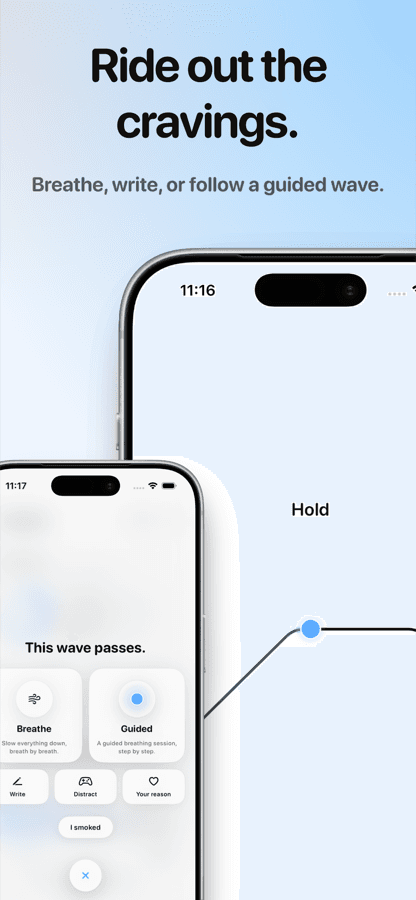
11
One small thing to notice or change at a time.
The daily course does not ask you to solve everything at once. Each short lesson ends with one thing you can do in the day in front of you.
The morning, the offered cigarette, the difficult day, and the moment after one each get their own space.
12
One cigarette does not have to become a verdict.
If one gets through, log what happened. The time, place, thought, and situation are still useful. Nothing you noticed before it disappears.
One bad Tuesday is not the end of the map. It is still there on Wednesday.
Use seven days to see whether your moments repeat.
Start with the day you already have. The US web offer is $29.99 every three months, or $14.99 per month, with no free trial. Use the same email when you open BeQuit on your iPhone.
Cancel before the next renewal to avoid another charge. You can manage the subscription from your billing page.